Your download link is delivered immediately via email after checkout
Discipline vs Motivation: The Brutal Truth About Consistency
Discipline vs motivation explained: learn why motivation fades and how discipline creates long-term consistency and success.
Polaris Star Editorial
3/5/20263 min read
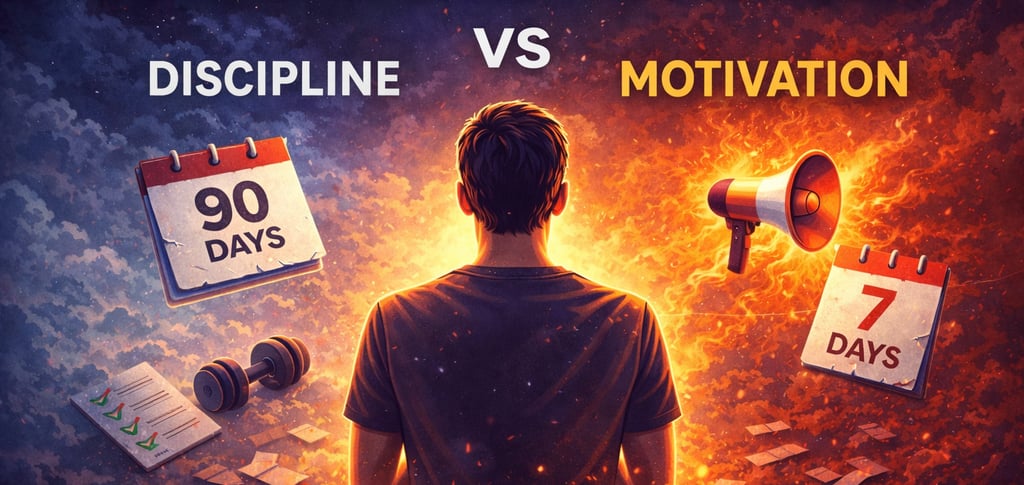
Discipline vs Motivation: The Brutal Truth About Consistency
Most people believe success starts with motivation.
A powerful speech.
A burst of excitement.
A sudden urge to change your life.
And for a few days, motivation works.
You wake up early.
You exercise.
You focus.
Then something happens.
Motivation disappears.
Suddenly the alarm feels heavier.
The gym feels optional.
The goal feels distant.
This is where most people quit.
Not because they are weak — but because they relied on the wrong fuel.
What Motivation Actually Is
Motivation is emotional energy.
It appears when:
You watch something inspiring
You imagine a better future
You feel excited about change
But emotions are unstable.
They rise and fall constantly.
Motivation works best at the beginning of a journey, not during the difficult middle.
That’s why so many people start strong and disappear after a few days.
In fact, as discussed in the article “Why Most People Quit After 7 Days,” the first week of any goal is usually driven by motivation. Once the excitement fades, consistency becomes difficult.
Motivation starts the engine.
But it cannot drive the entire journey.
What Discipline Really Means
Discipline is different.
Discipline is not emotional.
It is behavioral.
Discipline means doing the task even when you don’t feel like it.
No excitement.
No inspiration.
No emotional push.
Just commitment.
This is the invisible force behind every long-term transformation.
Athletes rely on discipline.
Entrepreneurs rely on discipline.
Creators rely on discipline.
Motivation is temporary.
Discipline is structural.
Why Motivation Always Fails Eventually
Here’s the uncomfortable truth.
If your progress depends on feeling motivated, you will stop sooner or later.
Because motivation disappears when:
You feel tired
You face difficulty
You see slow results
You become bored
And real progress contains all four of these elements.
This is why motivation alone cannot sustain a long-term goal.
Motivation is emotional fuel.
Discipline is mechanical fuel.
Mechanical systems run longer.
Discipline Builds Identity
One powerful reason discipline works is identity change.
Every time you repeat a disciplined action, your brain records evidence.
Evidence that says:
“I am someone who follows through.”
This evidence compounds over time.
That’s why long commitments — like the 90-Day Reset Rule discussed in the previous article — are powerful. They create enough repetition for behavior to become identity.
And once something becomes identity, consistency becomes natural.
The Real Relationship Between Discipline and Motivation
Here’s something interesting.
Motivation can disappear.
But discipline often creates new motivation later.
For example:
You force yourself to work out even when you don’t want to.
After finishing, you feel proud.
That pride creates motivation again.
This means motivation is not the cause of discipline.
It’s often the result of discipline.
People who wait for motivation never start.
People who act despite low motivation generate it afterward.
How to Build Discipline (Even If You Feel Lazy)
Discipline is not a personality trait.
It is a trained behavior.
Here are practical ways to strengthen it.
1. Reduce Decision Fatigue
Make fewer choices.
Set a fixed routine for important tasks.
For example:
Same workout time daily
Same work schedule
Same study hours
Less thinking. More action.
2. Focus on Systems, Not Goals
Goals create excitement.
Systems create results.
Instead of saying:
“I want to get fit.”
Say:
“I train every morning.”
Instead of chasing outcomes, build repeatable systems.
3. Lower the Daily Barrier
Discipline fails when tasks feel overwhelming.
Reduce the starting difficulty.
Example:
Instead of reading 30 pages, start with 5.
Instead of working 3 hours, begin with 20 minutes.
Starting builds momentum.
Momentum builds discipline.
4. Track Consistency
Your brain loves visible progress.
Use a habit tracker or calendar.
Every completed day becomes proof of discipline.
Breaking a streak becomes psychologically painful — which helps maintain consistency.
Why Discipline Feels Boring (And Why That’s Good)
Discipline is not exciting.
It is repetitive.
It lacks drama.
And because it lacks excitement, people assume it’s not powerful.
But boring consistency is exactly what produces extraordinary results.
Most successful people don’t rely on bursts of motivation.
They rely on structured routines executed daily.
Consistency looks ordinary from the outside.
But its long-term impact is extraordinary.
Final Thoughts: Motivation Starts. Discipline Finishes.
Motivation is useful.
It can inspire the first step.
But it cannot carry you across the finish line.
Only discipline can do that.
Motivation is a spark.
Discipline is the engine.
And the people who build engines instead of chasing sparks are the ones who eventually transform their lives.
FAQ
What is the difference between discipline and motivation?
Motivation is an emotional push to act, while discipline is the ability to act consistently regardless of emotions.
Can discipline be learned?
Yes. Discipline strengthens through repeated behavior and structured routines.
Why does motivation disappear so quickly?
Because motivation is based on emotional excitement, which naturally fades after the initial stage of any goal.